Zabuyelite — Li₂CO₃
Natural lithium carbonate. Extremely rare, highly reactive and soluble; dissolves in acid without roasting. Li₂O equivalent ≈ 40–46%.
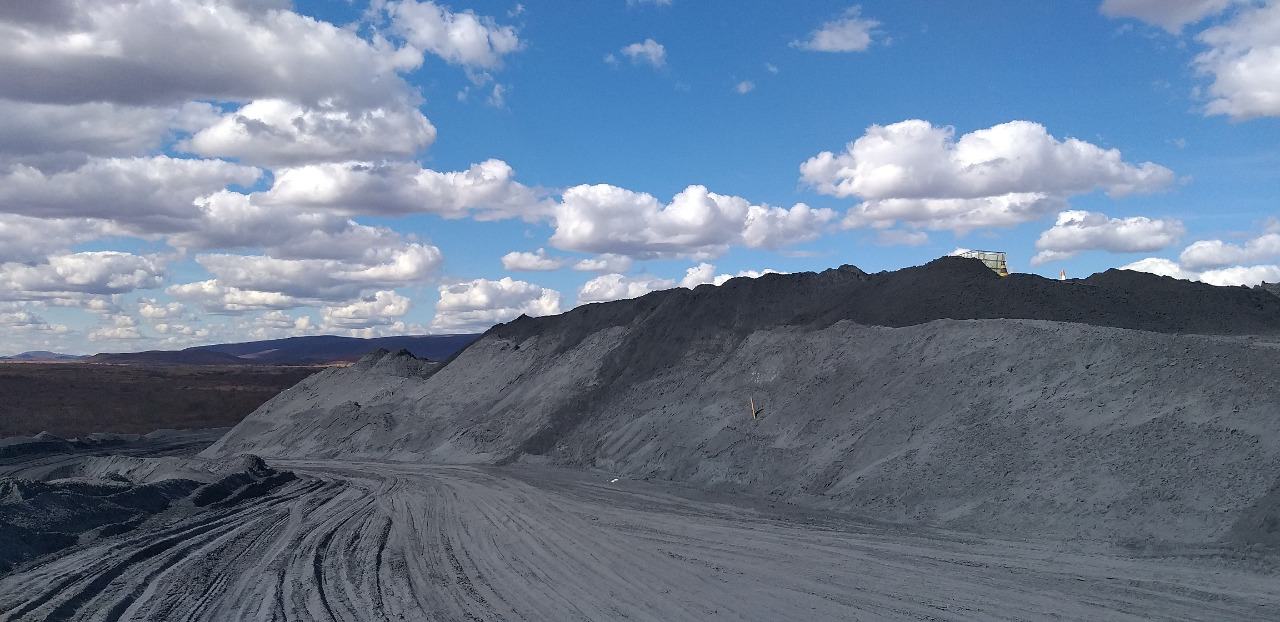
Investment opportunity · Northeast Brazil
Independent laboratories on four continents have reported elemental lithium (Li) grades between 9.8% and 10.7% in ore from a licensed, producing operation in Northeast Brazil. Behalf represents the asset and is structuring a local processing facility. This page is the summary; the data room is available under NDA.
Independent validation
Samples were prepared by borate fusion or equivalent high-temperature dissolution and analysed by ICP-MS, ICP-OES and AAS. Values are as reported by each laboratory. Full certificates are in the data room.
| Laboratory | Country | Method | Elemental Li (%) |
|---|---|---|---|
| ALS Canada | Canada | ICP-MS (fusion bead) | 10.7 |
| Bureau Veritas | Brazil | AAS (corrected) | 10.6 |
| ACS Analytica | Brazil | ICP-OES | 10.55 |
| AmSpec | Brazil | ICP-OES (fusion bead) | 9.8 – 10.06 |
| American Assay Laboratories | United States | ICP-MS | 10.4 |
| SGS Geosol | Brazil | ICP | 10.4 |
| Foshan Ceramics | China | ICP-MS | 9.91 |
| SGS China | China | ICP-MS | 7.65 |
For reference: a standard spodumene concentrate of 5.5–6.2% Li₂O contains roughly 2.6–2.9% elemental lithium.
Mineralogy
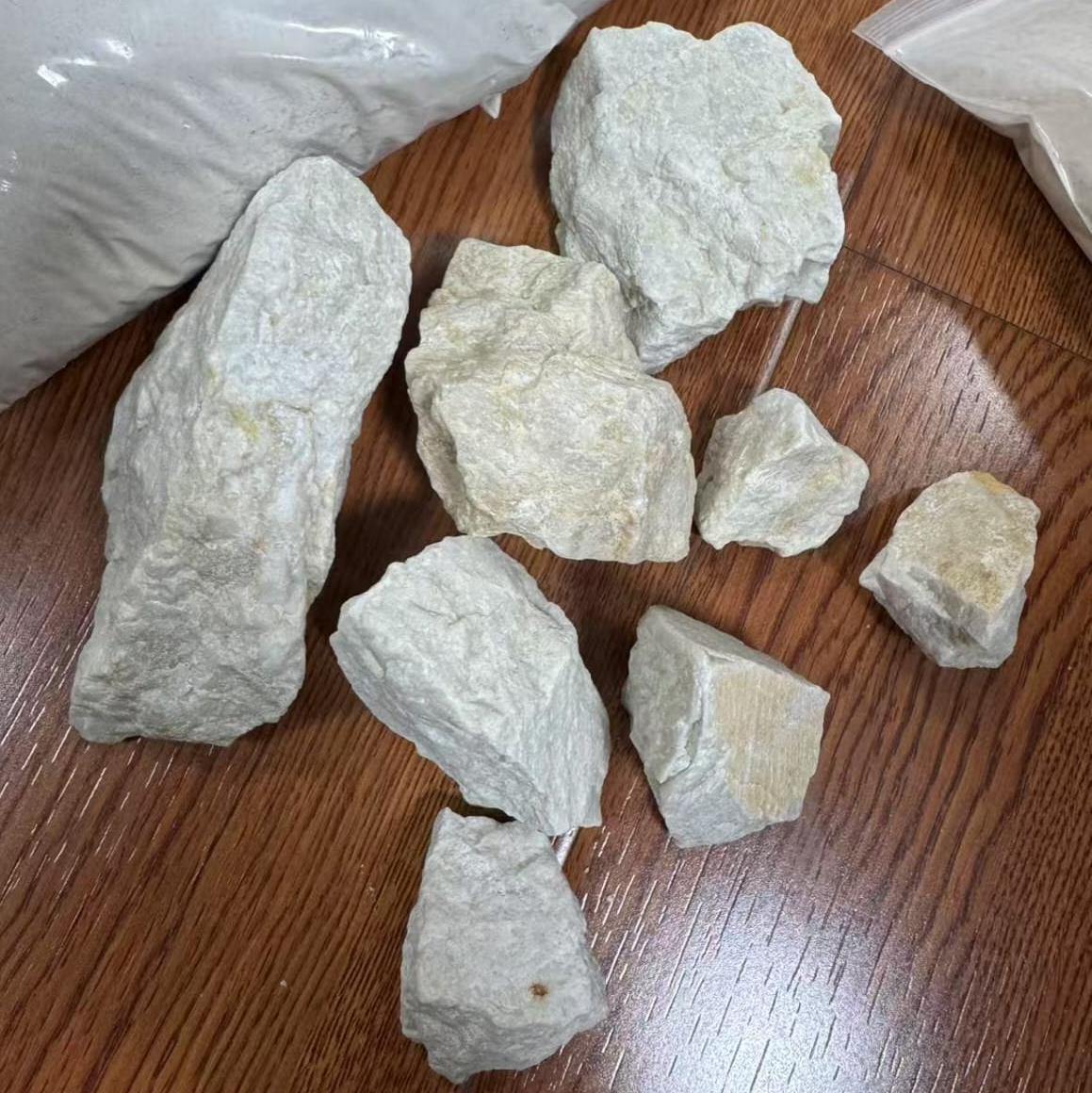
A carbonate–phosphate–silicate system: the lithium in this ore is hosted in a composite of three lithium minerals rather than in the pyroxene lattice of spodumene. Petrographic and XRD work confirms the assemblage; its chemistry is what makes the material behave like a chemical feedstock rather than a hard-rock concentrate.
Natural lithium carbonate. Extremely rare, highly reactive and soluble; dissolves in acid without roasting. Li₂O equivalent ≈ 40–46%.
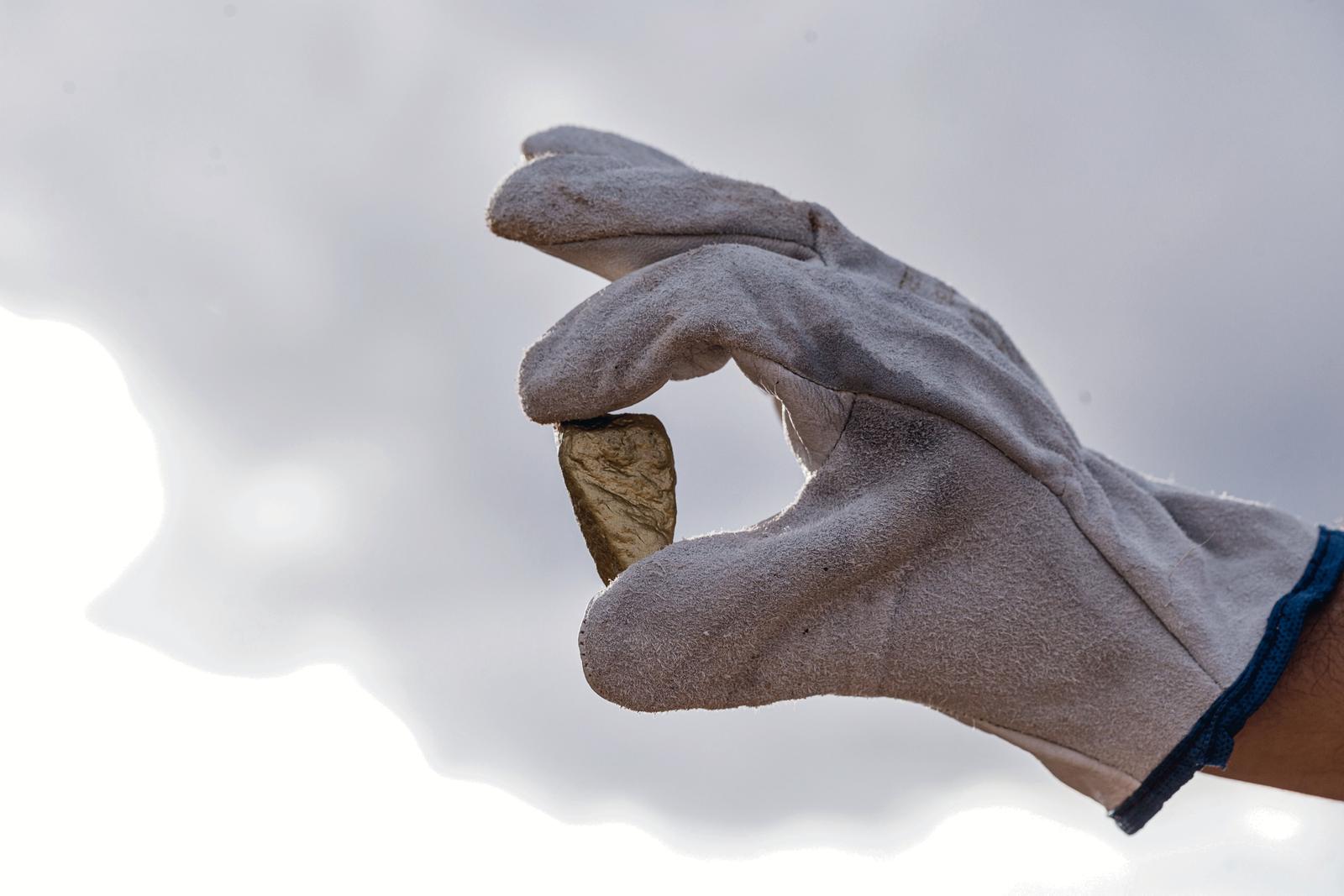
A powerful lithium carrier once digested; used in ceramics and LFP cathode chemistry. Li₂O equivalent ≈ 60–61%.
Stable and bond-dense; requires fusion to break the polymeric silicate chains. Li₂O equivalent ≈ 66%.
| Property | Spodumene (industry standard) | This ore |
|---|---|---|
| Mineral type | Pyroxene silicate — LiAlSi₂O₆ | Natural carbonate, phosphate and silicate of lithium |
| Typical grade | 5–6% Li₂O in concentrate | 9.8–10.7% elemental Li in ore |
| Processing | Roasting at 1,050–1,100 °C, then acid baking | No roasting; dissolves under controlled acid digestion |
| Reactivity | Poor; slow leaching | High; rapid solubility |
| Industrial role | Mineral concentrate requiring conversion | Behaves as a direct precursor to Li₂SO₄, Li₂CO₃ and LiOH |
| Energy in conversion | Reference | Project metallurgical work indicates 50–70% lower energy demand |
Validated extraction routes
Sulfuric fuming of the ore, calcination and water leaching, recovering lithium as lithium sulfate — the precursor for lithium hydroxide and carbonate. High retention and lithium yield.
80% CaO blended with 20% ore, heated to 150 °C, followed by lithium carbonate precipitation. A low-capex route with repeatable purity results — the natural basis for a first local processing module.
Analytical protocol
Most laboratories are calibrated for spodumene: direct ICP on ground rock, XRD phase identification, flame AAS without ionization control. Applied to a carbonate–phosphate–silicate matrix, these routines return false lows. Every high-grade result above was obtained after complete dissolution of the matrix.
Behalf provides calibration files, protocol guidance and live support to buyers' laboratories.
Operation and logistics
Operating licence in place. The operator is a private, family-owned group with more than forty years of uninterrupted mineral extraction, processing and export.
More than 80 million tonnes of lithium-bearing ore identified, with a measured-volume report filed with the national mining agency. Drilling across six boreholes to 30 m returned average grades between 6.5% and 11.8% elemental Li per hole.
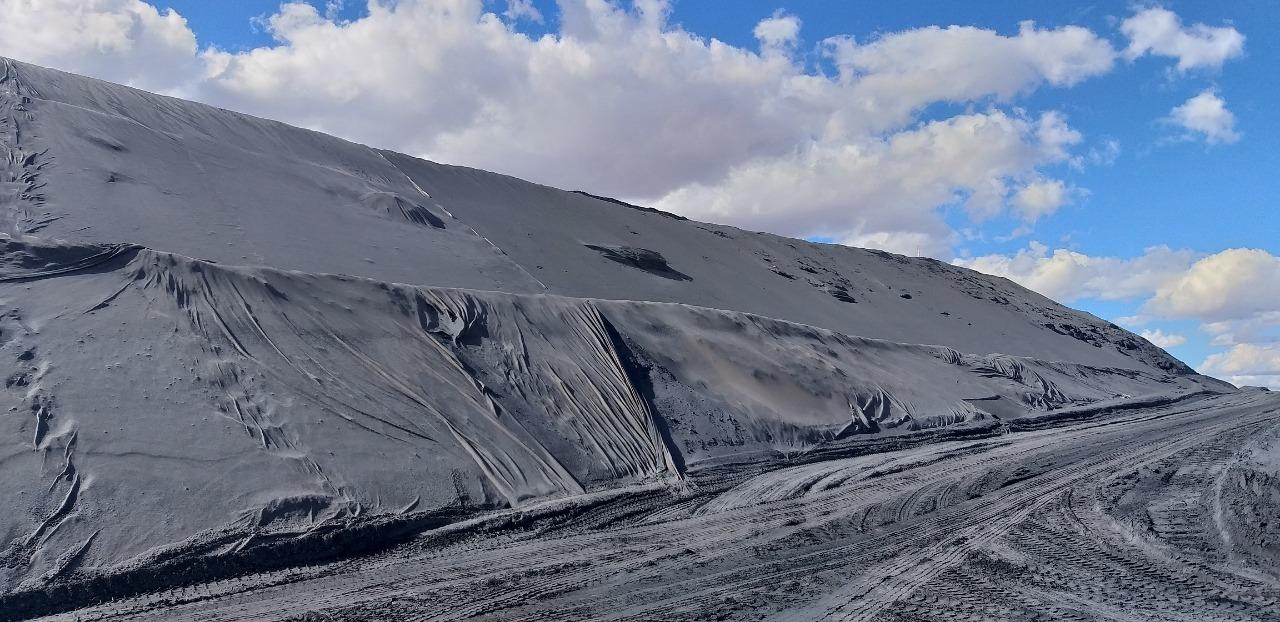
Production capacity of up to 100,000 tonnes per month, immediately scalable with minimal additional capital. Stockpile available; on-site sampling and rapid loading.
Paved highway access; 19 km from an industrial hub with a regional airport; about 240 km from a deep-water export port, with a second port as redundancy.
Stratified sampling across five levels; preparation by drying, crushing, quartering and pulverization; analysis by ICP, AAS and XRD. Associated elements include Nb, Zr, Y and rare earths.
Brazil: a stable mining jurisdiction with no export bans on lithium since foreign trade was liberalised in 2022, and a public investment agenda for critical minerals.
The investment case
Behalf is structuring a lithium processing facility adjacent to the ore body and is opening the opportunity to strategic and financial investors. Five reasons the economics favour conversion at source.
Brazil ships almost all of its lithium abroad as concentrate — about 99% of 2024 exports went to a single country. A local plant turns ore into lithium sulfate and carbonate next to the mine and keeps the value-add in the project.
No roasting step. The validated routes run at digestion and precipitation temperatures, which the project's metallurgical work translates into 50–70% lower energy demand and a leaner capital footprint per tonne of lithium chemical.
The ore is licensed, stockpiled and saleable today. Ore sales can fund development while the plant is engineered — the facility is built on an operating asset, not on a drilling promise.
Brazil removed prior-authorisation requirements on lithium foreign trade in 2022, and the mining sector projects US$21.3 billion of investment in critical and strategic minerals between 2026 and 2030.
Converters, cathode makers and governments are actively diversifying away from concentrated supply chains. A high-grade, non-spodumene source in a stable Western-hemisphere jurisdiction answers that demand directly.
Brazil and lithium
Sources: USGS Mineral Commodity Summaries 2026; S&P Global Commodity Insights (Aug 2025); IBRAM (2025 results); Decree 11.120/2022, Presidency of the Republic of Brazil.
Request the investor package or a certified sample. Data rooms are opened under NDA and non-circumvention agreement.